OVERCOMING MY FEAR OF WATER - TIPS FOR BEGINNERS OF ALL AGES (KIDS, ADULTS)
Swimming is a sport that is not natural to everyone.
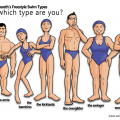
Walking, running, biking, all of these are quite easy to master, however, it takes some coordination and stamina to learn how to swim and to top it all off, before we improve our swim technique, we all have a different swimming style based on our physical ability which makes it that much more challenging.
The good news is that everyone can learn how to swim if given the right instructions. Below you will find a few novice tips that will help you conquer the world of water.
Before getting in the water, let's think about a few things.
First, swimming is done in a horizontal position which is not natural for many people. You might say "duh", but wait, read on.
Most beginner swimmers feel disoriented when laying on the water, they sometimes feel as if they will fall down or that they do not have control over their bodies. This causes the swimmer to try to swim over the water raising the upper body a little, therefore not following the horizontal plane. However, this feeling of falling should be overcome as it is not the case. Try to think of it more as laying down into a nice soft bed.
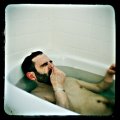
Second, let's stay with the bed analogy. When you lay down to sleep, your body is relaxed, all muscles are loosened up. This is very similar to how you should feel when floating in the water. Believe it or not, but the more relaxed you are the easier it is to stay afloat.
So listen to Frankie and RELAX.
Third, do not use any floating equipment. True, it is easier to kick with a kickboard or rely on some sort of a belt around your waist, however, most folks start getting dependent on the floating equipment and then it is hard to learn to swim the right way.
Fourth, BREATHE. Do not hold your breath. Every time you take a breath and put your face into the water, start slowly exhaling bubbles.
This will relax you and will let you enjoy your swimming exercise that much more.
If you are having trouble breathing, perhaps this drown proofing advice will help.
Fifth, do not be afraid, water is your friend. Many have mastered swimming before you, so why shouldn't you :)...
Now let's get to the good stuff. You are probably asking, so what do I do in the pool? How do I start?
Well, let's see:
1. If you are afraid of the water, you should start by standing up in the shallow end of the pool holding the wall and try to squat, so you get your chin close to the water.
Breath easily.
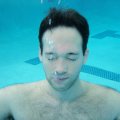
Once you are comfortable, try to go deeper underwater while holding your breath.
Now, don't just go up and down quickly, relax and use nice smooth motion to get up and down.
If that is ok, try to stay with your head submerged for longer. If you have your goggles, open your eyes, look around you and explore the beauty of the underwater world (you are almost like Kevin Costner now).
Try not to wear any floating devices that would help you with floating. Learning to float on your own is the way to go, so right from the beginning, you exercise the correct muscles and body positions.
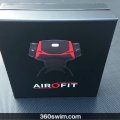
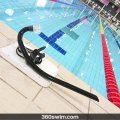
If you really need to have some sense of security, you can try the 360swim safety product which gives you a peace of mind.
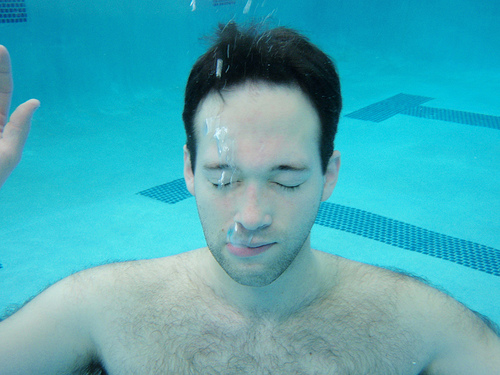
2. Now that you have mastered going underwater, it is time for bubbles.
Squat down holding the wall, so your mouth is submerged and start blowing bubbles through your mouth.
You are still nice and relaxed and going up, taking a breath, and down, blowing bubbles for a few seconds.
Try to increase the time you are under the water blowing bubbles.
The exhaling with bubbles helps you relax by not keeping you too uptight while holding your breath.
You can even count to 5 or any other number while blowing bubbles.
3. It is time you learn how to stand back up from the horizontal swimming position.
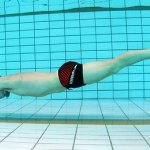
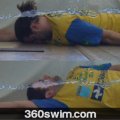
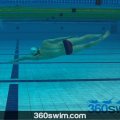
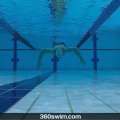
You are standing up, your arms are at your side, slowly lay on the water facing down while extending your arms above your head. So you end up laying on the water as a tree log stretching your arms as far forward as possible with your palms down.
Hold your breath (keep your mouth shut :)) and relax. Your body should be flat, the surface of the water should be hitting you on the back of your hair on top of your head, so get that chin toward your chest.
Don't be afraid to even get your head under the water a little.
Whenever you are ready to stand up, slowly bring your knees to your chest while keeping your arms extended forward and head under the water (in other words, you are still lookingat the bottom).
You will notice your body is changing positions from horizontal to vertical.
When your butt starts to sink begin slowly moving your straight arms (palms facing down) from the front above your head, down toward your hips keeping your arms straight. So, they will make nice half a circle.
Then when you are vertical, your face is still in the water, just extend your legs down to the bottom of the pool and rotate your head out of the water (backward).
Voila!
Now, try it with exhaling (blowing bubbles) when your head is underwater. This will help you relax more.
If you can master all the swimming skills I discussed above, you should be fairly comfortable being in the water.
If not, keep practicing, until you handle 1,2,3 with ease.
Good luck and remember, water is not evil. Don't think too much about it, we all have instincts to survive. :)
After you have handled the above with ease, feel free to move on to the next post where I show you how to start your first motion in the H20 or just dive straight into some swim lessons posts.
 LNURL1DP68GURN8GHJ7URP0YHRXD3SWDMKJMFWVDHK6TMVDE6HYMRS9A4HSCNCWFXSH3NN0H
- or simply send using my Lightning Address⚡swmtr@360swim.com or swmtr@getalby.com
FREE VIDEOS AND ADVICE VIA EMAIL












Comments (98)
I remember being taught something called the dead man's float at camp one year. For me, it was more of a dead man's sink. I would fill my lungs with air, relax every muscle in my body, and a few seconds later, I'd feel my toes brushing the bottom of the lake. Raising my head to take a breath was not an option.
I've aged since them, put on some more body fat, and now, I float just fine. I can even control what depth I float at by deciding how much air to keep in my lungs. But not everybody floats. I didn't, when I was a kid.
floating on water and it
was the first thing I taught
my son, Noah!
actually i didn't know how to swim .. but long time ago i tried that relaxed approach and I did stay afloat ..
I know how to swim now .. but i don't very often .. i should though.
If you get water in your nose, try to pucker up your upper lip, so it enclouses your holes, that helps for most (unless you have a beard :). And don't worry about using a noseplug. If it makes your swimming comfortable, then why not. After you get more used to water, you will be able to do it without. Keep it up.
Swimming is not hard, just takes a lot of time, practice and self-dedication to master. Yes, swimming classes can be helpful, however, you can learn on your own as well. Patience is the key. Also, if something doesn't work one way, try it another (one thing will work). Just remember, The more muscles you relax the more energy you can put into it, the faster you will swim.
Try searching on https://www.youtube.com for some swimming related words and you might find some good videos.
thank you very much for this, i always afraid by water, now i will follow your tips, and i think it will me sure thanks.
thank you.. i tried to start my friendship with water only just a day before... i will try this lesson next time when i go to beach...
1) float on your stomach
2) slowly bring your knees to your chest, so they are tucked in
3) assuming your arms are above your head pointing in the direction you are floating, make sure your palms are facing down, and move your straight arms towards your hips
4) since you were in a ball with legs tucked in, the arm movement toward your hips will rotate you into a vertical position, so the only thing that is left is to extend your legs to the bottom
tip: do not try to lift yourself out of the water, keep shoulders and butt in the water at all times.
@Pools: that is very unfortunate that you were taught by getting thrown into the water. This is not very good. If you are teaching your children, they need to trust you, so if you say you will catch them or you will not move from one spot, do exactly as you said. Otherwise, you are fighting an uphill battle. Psychology plays a big role in teaching children how to swim.
I tend to be one of those so-called people. I've been trying for all my life to get pass the tense part., I cannot even float on my back neither on my stomach and I've practicing regularly and I have followed swimming courses. I suppose not all humans are made to swim. So, If you are one of those, sorry to disappoint I think it might just be genetic...
I am 26 and i always wanted to swim...but i think i m scared of water. I just joined a swimming club, the coach is not very supportive, but my swim mates are nice, they help me...But all of them say that I dont relax my body..please tell me what to do to relax my body..I really wnat to b a gud swimmer.
I just started my first swimming lesson yesterday. Very disappointed with myself. I can't bring my hips and legs straight up in water in horizontal position. i try my best to float but I can't. Will I learn swimming.
i always scared from water but when i read it you kill my fear n now i join swimming club and i really floating in two days ........... wallah behtareen tip.
I wanna know that if i drawning down in the deep area what should i do.
thanks
1) if you are not comfortable in shallow area - DO NOT go to deep area :)
2) your fear should not be about drowning. if you are going to have a fear, you should fear not sticking to what you learned and panicing. As panic is the worst.
3) if you do happen to feel like you are going to sink and you are in the pool where the depth is 3-5m, then don't panic and just sink down to the bottom and push off to get a breath in.
Try reading this article about what to do when you feel like you are drowning
to Jealsa: thanks for sharing your fear. The compression of your chest is a common issue for many beginners. I'd say that the pressure on your chest is actually not as big as you think it is. What you feel as a huge pressure is escalated by your fear. In reality, it is not that big of a difference in pressure right at the surface of the water. To help with this, you should start in a shallower water and most importantly in a very warm water, so you are comfortable and eliminate any other discomforts. And slowly submerge up to your belly button first and see if you breathing is ok, then keep going by very slow increments to get deeper and deeper and always stop when you feel discomfort and hold the position until you are comfortable. You can also try to close your eyes and focus on something to relax you like laying on a sunny beach etc.
Getting water in your ears is just a feeling you can get used to after a lot of practice. You can just practice getting your head under the water while standing or kneeling on the pool bottom and each time try to stay under water for longer. Perhaps try to listen to any sounds you may hear under the water and that could keep your mind occupied and not worrying about how your ears feel.
jst keep on giving this sort of amazing tips for beginners.
to my back I went underwater and almost drowned, Suddenly I remembered instruction given to fellow swimmer , i.e to breathe in to come up.So I breathed in and came on surface. Is it right method ? or some other way ! Suppose water had been 15 meter deep would I have come up by breathing in or drowned
Breathing in is very important part of floating. Your lungs serve as balloon, so if you fill up the balloon (your lungs) with air, they will keep your body floating on the surface. Taking a nice long deep breath will bring more air into your lungs. Check out this post about how to relax in the water which goes through some sinking exercises.
2)How many minutes novice can float in horizontal as well as verticle position?
1)I am not sure how long can swimmer hold his breath without injury to brain, but there are people able to hold their breath for 10 minutes.
2)That is a difficult question and there is no answer to it. A person can float in horizontal/vertical position for a very very long time. If someone would feed you, you could float forever :) (assuming you keep taking breaths). Your body's buoyancy does not drastically change for you to sink. However, a novice swimmer/floater might be too rigid and not relaxed enough to be able to do this, so perhaps a few minutes.
if you struggle with floating, the following post can help you with learning how to float.
I wish I could float on my belly or front float for few minutes ,say 5-7 minutes ,recover my breath and start swimming again .Is it possible for me? because I need to swim 25 meters which is essential condition of my swimming pool to certify that one is swimmer. Kindly advice
If you want to float for 5-7 minutes, you should do it on your back as that is much easier to breathe.
The reason you get tired could be that your body is tense and you more than likely kick in a hectic manner which burns oxygen. Try to relax more :).
To float on your stomach for 5-7 minutes while also taking breaths, you'll need to learn the sculling technique.
Take my advice first stand in shallow water which is not deeper than your chest.Hold floater/kickborad on your hand but do not tie anything on your back, take deep breath hold it and lie on water in relaxed manner when you feel you are going down bring both legs forward to your chest together while holding floater by both hands ,raise your head and put your both legs and hand down.
This way you can stand in water which will build your confidence.
2swim.blogspot.com
Thanksto your encouraging words, i am not giving up yet!
Firstly I got her to float on her back with my hand under her head, then to lower her arms to point down with palms facing her feet, then to swing her arms forwards and upwards, which automatically swung her feet to the ground. After a few repetitions we reversed the process so that she could go from standing to the floating position. We then did the with her floating on her front.
The next step was with her floating on her front, with one arm forward and the other pointing down. taught her how to rotate onto her back
40mins later she could do all of the exercises without my help and after a couple of extra sessions I did not need to be close to her.
The rest was easy
Help!I can't seem to immerse my head in water, once I get to my ear level can't go further. My problem isn't holding my breath (or a fear of the water)because if i stand and then bend my head with my face into the water it's fine but when my head is vertical, i just can't seem to get in past my upper lip/the bottom of my ears. How do I overcome this.. i really wanna learn. I'm 34.